Hidden Giants: The Secret Landmarks of Aoraki / Mount Cook
You’ve seen the postcards of New Zealand’s highest peak, but have you truly discovered its quiet wonders? Beyond the hiking trails and photo stops lie unexpected architectural echoes — alpine huts, forgotten shelters, and courage-built structures that blend into the landscape. I’m talking about the hidden landmarks of Aoraki / Mount Cook, where nature and human grit intersect. This is not just a mountain — it’s a story written in snow, stone, and steel. These modest yet meaningful structures tell of survival, purpose, and quiet resilience. They stand not to impress, but to serve — and in doing so, they invite us to look beyond the summit and listen to the mountain’s deeper voice.
The Mountain That Watches Over All
Aoraki / Mount Cook rises with quiet authority at the heart of New Zealand’s South Island, standing 3,724 meters above sea level as the nation’s highest peak. Its dual name reflects a deep cultural heritage: Aoraki, from the Māori language, carries spiritual weight among the Ngāi Tahu people, who regard the mountain as an ancestor and a sacred presence. The name Mount Cook, bestowed in the 19th century, honors Captain James Cook, though it does not carry the same depth of reverence. In 1998, the official recognition of both names marked a step toward honoring this layered identity, and today the dual nomenclature is more than symbolic — it reflects a living relationship between land, people, and history.
Aoraki / Mount Cook is not merely a geographic landmark; it is a guardian of the alpine landscape, shaping weather patterns, feeding glaciers, and anchoring one of the most dramatic wilderness regions in the world. The mountain sits within Aoraki / Mount Cook National Park, part of Te Wāhipounamu – South West New Zealand, a UNESCO World Heritage Area recognized for its outstanding natural values. Unlike many famous peaks that have been commercialized or overrun by mass tourism, Aoraki retains a sense of solitude and solemnity. There are no cable cars, no luxury lodges on the upper slopes, and no easy paths to the summit. This restraint is by design — a reflection of both natural challenge and cultural respect.
For visitors, the mountain offers more than breathtaking views. It offers perspective. The scale of the landscape humbles even the most seasoned travelers. On clear days, the peak glows with an ethereal light, its snowfields catching the first rays of dawn. But Aoraki is not always visible. Clouds often shroud its summit, as if the mountain chooses when to reveal itself. This unpredictability adds to its mystique, reminding all who come near that this place operates on its own terms. It does not exist for spectacle. It simply is — enduring, watchful, and deeply connected to the rhythms of the natural world.
What Makes a Landmark “Hidden”?
When we think of landmarks, we often imagine grand monuments — towering spires, ancient ruins, or iconic bridges. But in the alpine world, landmarks are not always designed to stand out. Some of the most meaningful structures are those that blend into the landscape, their significance known only to those who seek them. In the context of Aoraki / Mount Cook, a “hidden” landmark is not necessarily unknown, but underappreciated — overlooked by mainstream tourism, absent from brochures, or unnoticed by casual visitors. These are places that do not announce themselves with signs or visitor centers. Instead, they reveal themselves slowly, to those who walk the quiet trails and look beyond the obvious.
Take, for example, a simple wooden hut perched on a rocky ledge, its roof dusted with snow. To a passing hiker, it might seem unremarkable — just another shelter in the backcountry. But to a climber caught in a sudden storm, it is a lifeline. To a historian, it is a record of human endeavor. To a descendant of early alpine explorers, it is a connection to the past. The hidden nature of these sites lies not in secrecy, but in perspective. Their value becomes clear only when one understands the conditions they were built for, the journeys they supported, and the silence they inhabit.
Many of these structures were built with purpose, not prestige. They were not constructed for tourists, but for survival — to provide refuge, support scientific work, or enable exploration. Their modest design reflects a philosophy of humility in the face of nature. Unlike urban architecture, which often seeks to dominate space, alpine buildings aim to coexist. They are low to the ground, built from local materials when possible, and designed to withstand extreme weather. Their integration into the environment makes them easy to miss, but once seen, they leave a lasting impression. In a world where so much is loud and attention-seeking, these quiet structures remind us that strength does not always shout — sometimes, it whispers.
The Hermit’s Hut: A Secret Shelter at the Edge of the World
Nestled in a rugged corner of the national park, near the base of the Sealy Tarns track and overlooking the vast expanse of the Mueller Glacier, stands a small alpine hut known informally as the Hermit’s Hut. Officially unnamed and unmarked on public maps, it exists in the quiet margins of the backcountry, known primarily to experienced trampers, park rangers, and members of the Department of Conservation (DOC). Built in the mid-20th century, it served as a temporary shelter for surveyors mapping the region and later as a refuge for climbers preparing for ascents of Aoraki’s upper slopes. Its isolation and lack of signage contribute to its hidden status — it is not a destination advertised to the public, but a functional structure maintained for safety and continuity.
The hut itself is unassuming: a compact wooden cabin with a corrugated iron roof, painted a faded green that blends with the surrounding alpine scrub. Inside, it is spartan — bunk beds with foam mattresses, a small table, and a wood-burning stove. There is no electricity, no running water, and no communication system. What it offers is protection — from high winds, sudden snowstorms, and the disorienting fog that can roll in without warning. For those caught in deteriorating conditions, the Hermit’s Hut is more than a shelter; it is a sanctuary. Its presence has likely saved lives, though such stories are rarely publicized.
What gives the hut its emotional weight is not its architecture, but its context. It stands at the edge of one of the most remote and unforgiving environments in New Zealand. To reach it requires a full day of hiking, strong navigation skills, and preparation for rapidly changing weather. Yet, for those who make the journey, the experience is transformative. Sitting inside on a stormy evening, listening to the wind rattle the windows, one gains a visceral understanding of the mountain’s power. The hut does not conquer the environment — it endures within it. And in that endurance, it becomes a symbol of human resilience, not as triumph, but as quiet perseverance.
Adelie Hut: Where History Stands Quietly in the Snow
Further into the backcountry, in a valley once used for military-style survival training, lies the Adelie Hut — a relic of New Zealand’s role in Antarctic exploration. Built in the 1950s, this small structure was used by Sir Edmund Hillary and his team during their preparations for the Commonwealth Trans-Antarctic Expedition. Named after the Adélie penguin, a symbol of the Antarctic, the hut served as a base for cold-weather testing, equipment trials, and team bonding in extreme conditions. Though modest in size, its historical significance is profound. It represents a chapter in New Zealand’s contribution to polar science and exploration, a legacy that continues today through the country’s involvement in Antarctic research programs.
The Adelie Hut remains standing in the Adelie Valley, maintained in a conserved state by the DOC. It is not open for casual visitation, nor is it advertised as a tourist attraction. Access is typically restricted to guided scientific parties, conservation workers, and authorized tramping groups with specific permits. This protection ensures that the site is preserved as a historical artifact, not degraded by unmanaged foot traffic. The hut’s exterior is weathered but intact, its wooden frame reinforced over time to prevent collapse. Inside, original equipment — including cold-weather gear, cooking supplies, and handwritten notes — has been carefully cataloged and stored, with replicas placed to reflect its original use.
Visiting the Adelie Hut is not about nostalgia — it is about continuity. It connects modern travelers to a time when exploration was defined by preparation, patience, and partnership with the environment. Hillary and his team did not see the alpine landscape as an obstacle, but as a teacher. They learned from the mountain, adapting their methods to its rhythms. Today, the hut stands as a reminder that true progress is not measured by speed or convenience, but by respect and readiness. For those who are permitted to see it, the experience is humbling — a moment of stillness in a world that often moves too fast.
Tomato Sauce Shack: An Odd Charm in the Alpine Cold
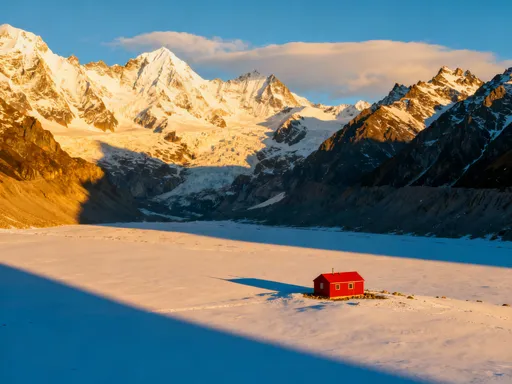
Not all hidden landmarks are solemn or historic. Some carry a touch of humor, a human signature that defies the severity of the alpine world. One such structure is affectionately known among locals as the Tomato Sauce Shack. Officially, it is a field research cabin operated by the National Institute of Water and Atmospheric Research (NIWA), located near the Hooker Valley, used for glacial monitoring and weather data collection. But its bright red exterior — painted in a shade suspiciously similar to that of a popular brand of tomato sauce — earned it its unofficial nickname decades ago, and the name has stuck.
The shack is small, barely large enough for two researchers to work inside, with insulated walls, solar panels on the roof, and a satellite antenna for data transmission. Its primary function is scientific: it houses instruments that measure temperature, wind speed, and glacial movement, contributing to long-term climate studies. But its personality comes from its color and its story. Legend has it that the paint was leftover from a supply drop meant for a different site, and rather than wait for the correct shade, the team used what was available. The result was a cheerful burst of red in an otherwise monochrome landscape — a small act of practicality that became a local legend.
The Tomato Sauce Shack represents an important truth about life in remote environments: survival is not just physical, but emotional. A little humor, a splash of color, a shared joke — these are not luxuries, but necessities. In the isolation of the alpine world, where conditions are harsh and help is hours away, morale matters. The shack, with its playful nickname and vivid presence, reminds us that even in the most serious work, humanity finds ways to express itself. It is not a tourist destination, but those who spot it on the trail often smile — a small moment of warmth in the cold.
Beyond the Summit: Why These Structures Matter
The true value of Aoraki’s hidden landmarks lies not in their physical form, but in what they represent. These structures — whether a backcountry shelter, a historical hut, or a research cabin — are expressions of human purpose in a landscape that demands humility. They were not built for glory, but for function. They do not dominate the terrain; they respond to it. In an age when travel often emphasizes convenience and comfort, these sites remind us that some of the most meaningful experiences come from simplicity, challenge, and connection.
Each of these landmarks reflects a different aspect of our relationship with nature. The Hermit’s Hut speaks to survival and safety, offering refuge in a place where the elements are unpredictable. The Adelie Hut connects us to history and exploration, grounding modern travel in a legacy of preparation and discovery. The Tomato Sauce Shack highlights creativity and morale, showing that even in scientific work, human spirit finds a way to shine. Together, they form a quiet network of meaning across the alpine landscape — not a monument to conquest, but a testament to coexistence.
Moreover, these structures align with the principles of sustainable tourism. They are low-impact by design, built to last but not to expand. They serve specific purposes and are maintained with care. The Department of Conservation manages access thoughtfully, ensuring that these sites are preserved for future generations. This approach reflects a broader philosophy: that travel should leave minimal trace and maximum respect. For visitors, engaging with these landmarks means slowing down, looking closely, and understanding that the mountain’s value is not in what we take from it, but in what we learn from it.
How to Discover These Hidden Gems (Without Damaging Them)
Discovering the hidden landmarks of Aoraki / Mount Cook requires more than a map — it requires preparation, respect, and a commitment to responsible travel. The best time to visit is during the alpine summer, from November to April, when daylight is long, snow levels are lower, and weather conditions are more stable. However, even in summer, conditions can change rapidly. Temperatures can drop below freezing at night, and storms can develop with little warning. Proper gear is essential: sturdy hiking boots, layered clothing, a waterproof jacket, navigation tools, and emergency supplies including a first-aid kit and a thermal blanket.
For those seeking to explore beyond the main trails, several DOC tracks provide access to the backcountry. The Mueller Glacier Track, the Sealy Tarns Circuit, and the Hooker Valley Track are well-maintained and signposted, offering stunning views and opportunities to spot alpine wildlife such as kea parrots and rock wrens. To reach more remote sites like the Hermit’s Hut or the Adelie Valley, advanced planning is required. These areas are not part of standard tourist routes and may require backcountry navigation skills, alpine experience, and in some cases, a permit. It is crucial to check with the DOC visitor center in Mount Cook Village for up-to-date trail conditions, weather forecasts, and safety advisories before setting out.
Equally important is the ethical dimension of exploration. Many of these structures are not meant for casual use. The Hermit’s Hut, for example, is intended for emergency shelter only — occupying it without need could prevent its use by someone in distress. The Adelie Hut is a protected historical site, and access is restricted to preserve its integrity. Even the Tomato Sauce Shack, while visible from a distance, is an active research facility and should not be approached without authorization. Visitors are encouraged to observe Leave No Trace principles: pack out all waste, avoid disturbing vegetation, and refrain from leaving marks or graffiti.
Ultimately, discovering these hidden landmarks is not about checking them off a list. It is about cultivating awareness — learning to see the mountain not just as a backdrop, but as a living environment shaped by both nature and human presence. It is about understanding that some of the most powerful stories are not told in words, but in the quiet endurance of a hut in the snow, a cabin on the ridge, or a red shack in the valley.
Conclusion: More Than Stone and Timber
Aoraki / Mount Cook is more than a peak to be climbed or a view to be photographed. It is a landscape of stories, written in ice and stone, sheltered in wood and steel. The hidden landmarks scattered across its slopes are not monuments to human achievement, but quiet acknowledgments of our place within the natural world. They speak of preparation, resilience, and respect — values that transcend time and remain relevant to every traveler who enters this alpine realm.
True discovery does not come from standing at the highest point, but from learning to see deeply. It comes from noticing the small cabin half-buried in snow, the weathered sign on a historic hut, the red roof glowing in the morning light. It comes from understanding that these structures were built not for fame, but for purpose — to protect, to study, to endure. In a world that often measures worth by visibility, these hidden landmarks remind us that meaning is not always loud. Sometimes, it is found in silence, in service, in the simple act of showing up and doing what is needed.
For the women and families who travel to Aoraki — many of them seeking not adventure for its own sake, but connection, clarity, and renewal — these quiet sites offer a different kind of inspiration. They speak to the strength found in care, the courage in preparation, and the beauty in modesty. They invite us to slow down, to listen, and to remember that the mountain reveals itself only to those who are willing to look beyond the surface. In the end, the journey is not about conquering the peak, but about being changed by it — one quiet landmark at a time.