Cuba’s Hidden Rhythms: What Happens When You Drive Into Trinidad’s Soul
You know that feeling when a place just gets you? I drove into Trinidad, Cuba with no real plan—just a beat-up rental car and curiosity. What I found wasn’t just colorful streets or old colonial charm. It was live music spilling from courtyards, spontaneous dance circles, and traditions alive in every alley. This isn’t just travel—it’s connection. If you’ve ever wanted to feel a culture, not just see it, this journey redefines what road trips can be. Trinidad, a UNESCO World Heritage site nestled along Cuba’s southern coast, offers more than preserved architecture; it pulses with rhythm, resilience, and warmth. And arriving by car—on your own terms—opens the door to moments most tourists never experience.
The Road to Trinidad: Why Driving Changes Everything
Driving through central Cuba is not merely about transportation—it’s an act of immersion. As the engine hums over sunbaked asphalt, the landscape unfolds in slow motion: endless sugarcane fields shimmering under the Caribbean sun, clusters of palm trees swaying at the roadside, and small villages where life moves at the pace of conversation. Unlike guided tours that follow rigid itineraries, self-driving allows for spontaneity. A farmer waving by the side of the road might lead to a roadside fruit stand. A cluster of children playing near a dirt path could signal a hidden beach just out of view. These are the unplanned pauses that define meaningful travel.
Road conditions vary, but they tell their own story. Paved highways connect major cities like Cienaga de Zapata to Santa Clara, yet many rural stretches remain uneven, with potholes patched by local crews using hand-laid stone. In these spaces, speed gives way to presence. You begin to notice more—the way a woman balances a basket on her head as she walks home, the sound of roosters echoing across quiet fields, the scent of woodsmoke curling from open-air kitchens. Navigation often relies less on GPS (which can be unreliable) and more on asking directions from locals, creating early bonds even before reaching your destination.
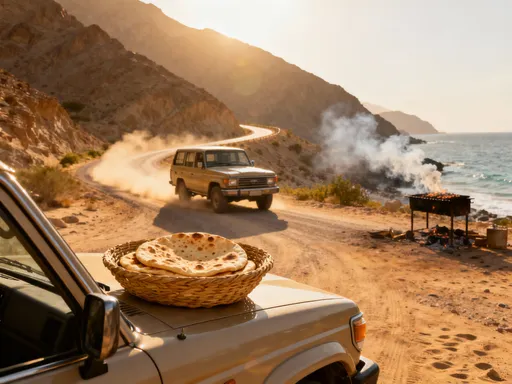
Renting a car in Cuba requires preparation. While international agencies operate in Havana and Santa Clara, availability fluctuates due to economic constraints and import limitations. Most rental vehicles are older models—Ladas, Moskvitches, or Chinese-made sedans—maintained with ingenuity and care. Fuel availability can be inconsistent, so planning refueling stops in larger towns is essential. Some drivers carry extra jerry cans, though this must be done legally and safely. Despite these challenges, the autonomy of having a car transforms the journey into something deeply personal. There’s a quiet pride in navigating unfamiliar roads, in solving problems with hand gestures and smiles, in knowing you’re seeing Cuba not through a tour bus window, but through the windshield of your own adventure.
Trinidad Unfiltered: First Impressions Beyond the Postcard
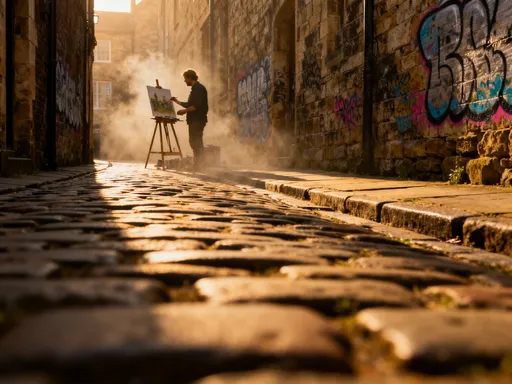
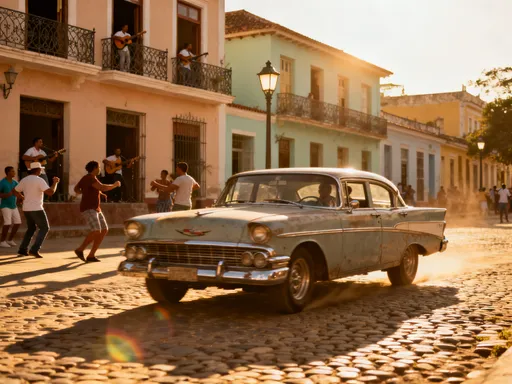
As the outskirts of Trinidad appear on the horizon, the transition feels almost cinematic. The flat plains give way to gentle hills, and soon, rooftops painted in faded ochre, sky blue, and coral pink emerge among the greenery. Cobblestone streets—worn smooth by centuries of foot traffic and horse-drawn carts—lead into the heart of town. Arriving by car offers a unique vantage point. Instead of being dropped off at a central plaza, you enter gradually, absorbing the rhythm of daily life before stepping into the tourist core.
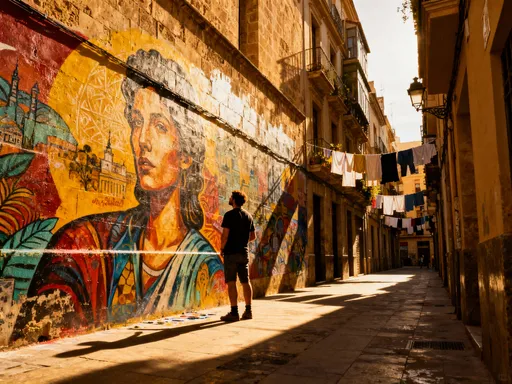
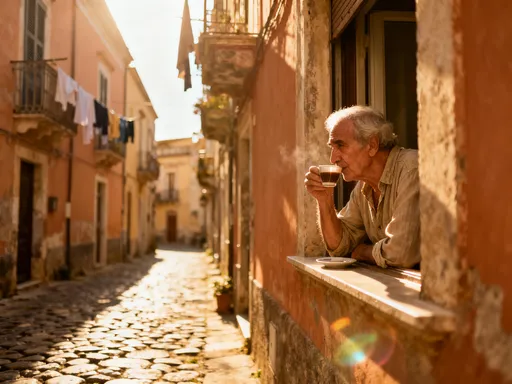
The Plaza Mayor, Trinidad’s main square, is undeniably beautiful—ringed by colonial buildings with wrought-iron balconies and shaded by towering royal palms. But the true soul of the city lies beyond its polished edges. In side alleys, laundry flaps between buildings like improvised flags. Elderly men play dominoes under a mango tree, their laughter punctuating the afternoon. A vendor roasts peanuts over a charcoal brazier, the smell mingling with sea breeze drifting in from Playa Ancón, six kilometers away. These are the unscripted moments that reveal a living culture, not a preserved exhibit.
Arriving independently allows travelers to observe before participating. There’s no rush to check into a hotel or join a guided walk. You can park near the edge of town, sit on a low wall with a bottle of local mineral water, and simply watch. Children pedal bicycles with mismatched wheels. A horse clip-clops past, pulling a wooden cart piled high with coconuts. A woman carries a bucket of fresh milk from a nearby farm. These details form a mosaic of everyday resilience and joy. When you finally step into the center, you’re not a spectator—you’re someone who has already begun to listen.
Music That Moves the Streets: Experiencing Live Son and Rumba
If Trinidad has a heartbeat, it is music. From early evening until late at night, sound spills from courtyards, bars, and open windows. The syncopated beat of congas, the bright call of trumpets, the rhythmic strum of the tres guitar—these are the sounds of son cubano, a genre born in eastern Cuba that became the foundation of salsa. In Trinidad, son is not performed for tourists; it is lived. It rises naturally from gatherings of friends, family celebrations, and neighborhood festivals.
One evening, near the edge of Parque Céspedes, a small group of musicians set up on a doorstep. No stage, no microphones—just a double bass, a pair of congas, and a singer with a voice like aged rum: deep, warm, and full of character. Within minutes, a circle forms. Locals sway, clap, and sing along. Tourists linger at the edges, some recording on phones, others stepping tentatively into the rhythm. But no one feels excluded. A man in a guayabera shirt gestures for a visitor to join the clapping pattern. “Palmas,” he says with a grin. “That’s half the music.”
Beyond public plazas, music thrives in private spaces. Some homes operate as informal *casas de música*, where for a modest entry fee, visitors can enjoy intimate performances. These are not commercial shows but community events, often funded by guest contributions to support local artists. Here, you might hear rumba—a Afro-Cuban genre rooted in religious and ceremonial traditions—with dancers moving in fluid, grounded steps that tell stories of ancestry and resistance. The drums speak, and the body answers.
Engaging with this music goes beyond listening. It means learning to recognize the clave rhythm, understanding that each genre has its own history, and respecting the cultural context. Son emerged from the blending of Spanish and African influences, shaped by centuries of social change. Rumba carries the legacy of enslaved communities who used dance and drumming as forms of expression and unity. When tourists participate—by clapping, dancing, or simply sitting quietly in appreciation—they become part of a living tradition, not just observers of it.
Dancing With Locals: When Culture Isn’t Watched—It’s Lived
There’s a moment, late in the evening, when the line between visitor and local blurs. It happens on a dimly lit street corner where a spontaneous dance circle has formed. A woman in a flowing dress takes your hand and pulls you in. “No pienses,” she says. “Don’t think. Just move.” And so you do—awkwardly at first, stepping on toes, laughing at your own stiffness. But then something shifts. The rhythm finds you. Your shoulders loosen. Your feet begin to follow the lead of those around you. This is not a dance lesson. It’s an invitation into shared joy.
In Trinidad, dancing is not performance—it is communication. Words may be limited, especially for travelers who don’t speak fluent Spanish, but movement transcends language. A turn, a smile, a hand held in invitation—these gestures create connection faster than any phrasebook. Children giggle as they mimic adult steps. Elders move with a grace that speaks of decades of practice. And newcomers, no matter how clumsy, are welcomed. The dance floor becomes a space of equality, where status, age, and origin dissolve into rhythm.
Driving makes these moments possible. Unlike those who must return to distant hotels by a certain hour, independent travelers can stay as long as the music plays. There’s no need to rush for a shuttle or worry about missing the last taxi. You can dance until midnight, then drive slowly back through the quiet streets, windows down, the echo of drums still in your chest. The freedom of the car extends the experience, allowing full immersion without logistical constraints. And in the morning, as you sip strong Cuban coffee on your balcony, the memory of the dance lingers—not as entertainment, but as human connection.
Off-the-Beaten-Path Encounters: Finding Culture Beyond the Center
While Trinidad’s historic center draws thousands, some of the most meaningful experiences lie just beyond its borders. And these are places only accessible by car. A short drive north leads to San Luis, a small village founded by freed Afro-Cuban slaves in the 19th century. Here, life moves at a gentler pace. Chickens peck at the dirt outside modest homes. Men repair fishing nets on porches. Women hang laundry between banana trees. It’s a place where history is not displayed in museums but lived in daily routines.
Visitors are greeted with curiosity, not commercial expectation. A family may invite you in for a glass of guava juice or a plate of *ropa vieja*—shredded beef stewed with tomatoes and peppers—cooked over a wood-fired stove. Conversations unfold slowly, translated through gestures and simple Spanish. An elder might share stories of growing up in the countryside, of working in sugarcane fields as a child, of how music and faith carried families through hard times. These exchanges are not scripted. They happen because you showed up, because you drove off the main road, because you knocked gently on a gate and waited.
Other excursions lead to small tobacco farms in the surrounding hills. Unlike the large plantations of Vuelta Abajo, these are family-run plots where farmers grow, cure, and roll cigars by hand. A tour might include watching leaves dry in wooden barns, learning how soil and climate affect flavor, and even trying your hand at rolling a simple cigar. The experience is educational, yes, but more importantly, it’s personal. You see the pride in a farmer’s eyes as he hands you a freshly rolled cigar, wrapped in banana leaf. You understand that this is not just a product—it’s a craft passed through generations.
These side journeys enrich the main destination. They remind travelers that culture is not confined to historic squares or museums. It lives in kitchens, fields, and front porches. And having a car means you can follow your curiosity, turn down a dirt road marked only by tire tracks, and discover something no tour group will ever see.
Challenges & Real Talk: What No One Tells You About Cuban Road Trips
Traveling by car in Cuba is not without difficulty. Anyone expecting a seamless, high-speed journey will need to adjust expectations. Fuel shortages are real. Gas stations may close without notice, or only serve vehicles with government-issued permits. Some drivers must wait in line for hours, sometimes overnight, to fill their tanks. Planning refueling stops in larger towns like Cienaga de Zapata or Sancti Spíritus is not optional—it’s essential.
Roadside checkpoints are common, especially near military zones or protected areas. Officers may ask for documentation—driver’s license, rental papers, passport copies. While most interactions are routine, it’s wise to keep documents organized and remain polite. Language barriers can complicate things, so carrying a simple Spanish phrase sheet helps. Patience is the most valuable tool. Things move slowly, not out of inefficiency, but because life here operates on a different rhythm—one that values relationship over speed.
Practical preparation is key. Travelers should carry water, snacks, a spare tire, basic tools, and cash in multiple currencies (Cuban pesos and foreign exchange). Mobile networks are limited, and GPS often fails in rural areas. Instead, many rely on paper maps and local advice. A friendly gas station attendant might draw a route on a napkin. A farmer might point you toward a shortcut known only to residents.
Yet these challenges are not obstacles—they are part of the experience. Waiting in line leads to conversations with Cuban drivers. A flat tire becomes an opportunity to meet a mechanic who fixes it with a patch and a story. Getting lost leads to a village festival you never knew existed. In embracing the unexpected, travelers discover resilience, hospitality, and humor. The difficulties don’t diminish the journey—they deepen it.
Why This Trip Stays With You: The Quiet Magic of Cultural Proximity
Months after returning home, certain moments from Trinidad remain vivid. The weight of a conga drum in your hands. The taste of warm bread from a neighborhood oven. The sound of an old man singing a bolero under a streetlamp. These are not just memories—they are touchpoints to a different way of being. Driving through Trinidad didn’t just take you to a destination; it created space for presence, for connection, for transformation.
What stays with you is not the photo you took, but the laugh you shared. Not the souvenir you bought, but the dance you learned. The car was more than a vehicle—it was a vessel for discovery. It allowed you to move at your own pace, to pause where you wished, to follow a melody down an alley or a rumor to a distant village. It gave you the freedom to be not just a tourist, but a participant.
In a world where travel often means checking boxes—museums visited, landmarks seen, photos posted—Trinidad reminds us of something deeper. Culture is not something to be consumed. It is something to be entered, with humility and openness. It lives in music, in movement, in shared meals and quiet conversations. It thrives in the spaces between plans, in the moments when we let go of control and allow a place to surprise us.
So if you go, go with a car. Go with curiosity. Go ready to listen more than you speak, to dance more than you watch, to connect more than you collect. Because in Trinidad, the road doesn’t just lead to a town. It leads to rhythm. To soul. To the quiet, enduring magic of being truly present.